JEE Main and JEE Advanced are the two stages of India’s engineering entrance examination system. Both exams assess students’ knowledge of Physics, Chemistry, and Mathematics, as they serve different purposes. JEE Main is the first-level examination used for admission to NITs, IIITs, and other engineering colleges, and it also acts as the qualifying exam for JEE Advanced. JEE Advanced is the second-level examination, taken only by top performers in JEE Main, and is the gateway to admission into the IITs. Compared to JEE Main, JEE Advanced is more challenging and focuses on deeper conceptual understanding and analytical problem-solving skills.
The dream of every science student in India who has a talent or keen interest in Physics, Chemistry and Mathematics is to get into a top engineering college. For many, this dream is like a feeling that all the effort will be worth it. But the path to reputed institutions is not a single or straightforward road. It’s a two-stage journey to conquer. Let us break down the difference between JEE Main and JEE Advanced.

JEE Main vs JEE Advanced
For a new aspirant, the confusion in the beginning is often overwhelming. What’s the difference between JEE Main and JEE Advanced? Are they the same exam? How do I prepare for both? It’s a common question, and understanding the core differences is the first and the most important step when it comes to your preparation.
Thinking about JEE Main and JEE Advanced? Don’t mistake them for the same test. Main checks your knowledge; Advanced tests your core understanding. This deeper thinking can’t be learned alone; it requires guidance from mentors who can instantly simplify the toughest physics or math concept. Typically, the main difference between JEE Main and JEE Advanced is that you get admission to an IIT via Advanced only. Let’s see some important differences between JEE Main and Advanced in the table shown below:
JEE Main vs JEE Advanced: Key Differences Overview
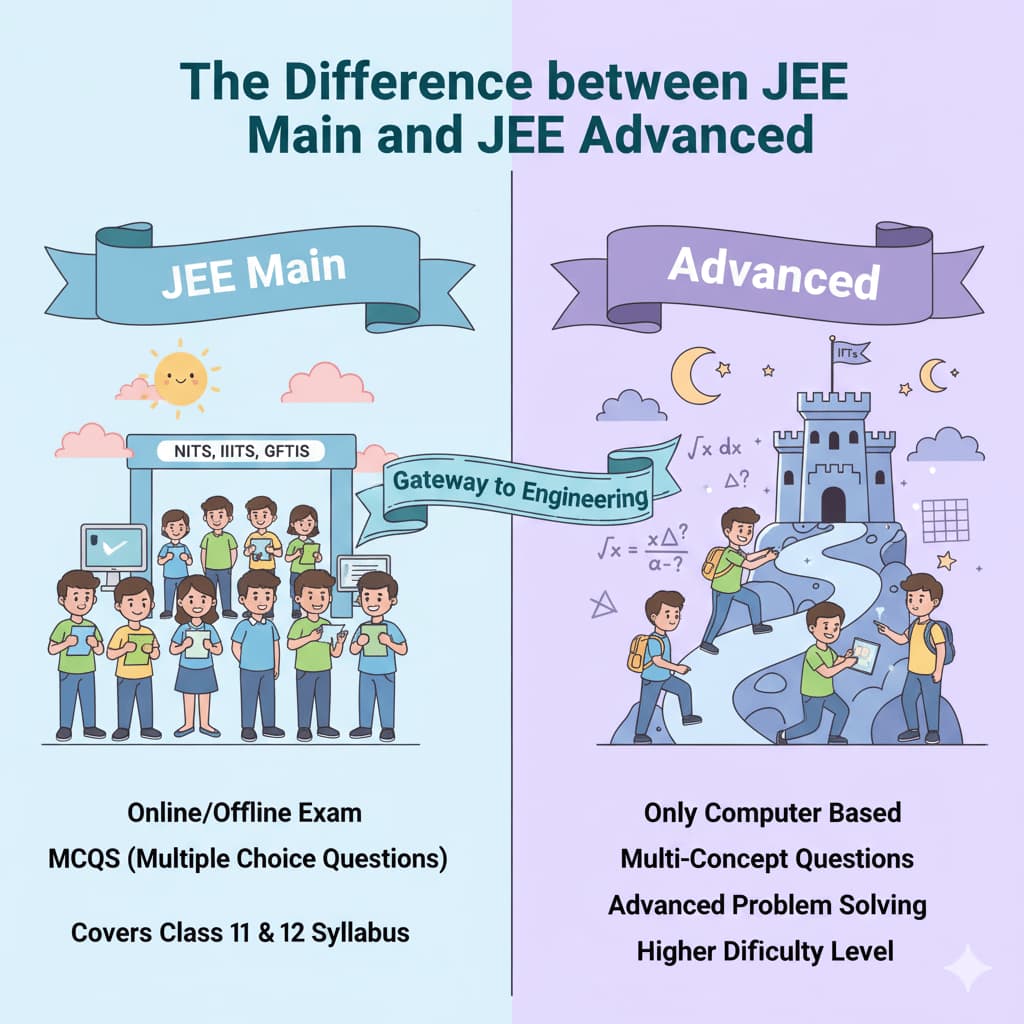
Here is a quick comparison overview of the JEE Main and JEE Advanced across every factor that shapes your preparation strategy. Check out the major differences mentioned in the table below.

| Parameter | JEE Main | JEE Advanced |
| Conducting Body | National Testing Agency (NTA) | IITs (on a rotational basis) |
| Frequency | Twice in a year (Jan and Apr) | Once in a year |
| Maximum Attempts | 6 across 3 years | 2 in 2 consecutive years |
| Eligibility | Class 12 pass or appearing | Only JEE Main Qualifiers (Top 2,50,000) |
| Papers | Paper 1 (B.E./B.Tech) Paper 2A & 2B: B.Arch., & B.Planning | 2 compulsory papers |
| Exam Pattern | 1 paper (PCM), CBT, MCQs + numerical, Fixed scheme (+4, -1), 300 marks. | 2 papers (PCM), CBT, MCQs, multiple-choice, numerical, matrix, etc. Marks & schemes vary. |
| Duration | 3 hours | 3 hours per paper |
| Question Format | Fixed MCQ and numerical | Changes every year |
| Marking Scheme | Fixed: +4 / -1 | Variable by question type |
| Language Options | English, Hindi, 13 regional languages | English and Hindi only |
| Colleges | NITs, IIITs, CFTIs | All 23 IITs |
What’s the Purpose of the JEE Main & JEE Advanced exam?
When students first approach the massive JEE challenge, they often confuse the goals of the two exams. Honestly, it’s the most common mistake we see. People think they are the two stages of the same race, but trust me, they serve fundamentally different purposes, and you can’t prepare for them the same way. You’ve got to know why you are taking each one to avoid wasting your time for months.
- JEE Main (Joint Entrance Examination Main): The purpose of JEE Main is to serve as an entrance exam for admission to undergraduate engineering courses in reputed institutes like National Institutes of Technology (NITs), Indian Institutes of Information Technology(IIITs), and other Government-funded Technical Institutes (GFTIs). It is also the qualifying exam for JEE Advanced. Its main objective is to serve as a pre-qualification test to filter out a large number of candidates. Many private and state-level engineering colleges also accept JEE Main scores for their admissions.
- JEE Advanced (Joint Entrance Examination Advanced): This is the second, more exclusive stage. Only the top performers from JEE Main are eligible to appear for JEE Advanced. Its sole purpose is to select candidates for admission to the undergraduate programs at the well-known Indian Institutes of Technology (IITs). If your ultimate goal is an IIT, this is the exam that truly counts. It’s the final hurdle to test the reading talent of the engineering aspirants.
So, in simple terms, you can’t even sit for JEE Advanced without first qualifying in JEE Main. This is the first and most important point to remember.
Difference in The JEE Main and JEE Advanced Exam Patterns
When you look at the JEE Main questions vs JEE Advanced ones, it almost feels like they’re testing two different brains. Main asks for a quick recall, but Advanced wants to see how you really think. That gap is where most students get stuck, and it’s why having a teacher who can simplify the crazy parts makes all the difference.
Here are the most crucial details of the exams themselves. The format of the two tests makes a major difference between the JEE Main and JEE Advanced.
JEE Main Exam Pattern
For Paper 1:
| Particulars | Details |
| Exam Mode | Online (Computer-Based Test) |
| Number of Sections/Subjects | 3 Sections of Physics, Chemistry, and Mathematics |
| Duration of Exam | 3 hours (180 minutes), 4 hours for PwD candidates |
| Type of Questions | MCQs: 4 options, with only 1 correct optionNumerical Value Questions (candidates must enter numerical answers) |
| Section A (MCQs) | Mathematics: 20Physics: 20Chemistry: 20 |
| Section B (Numerical Value) | Mathematics: 5Physics: 5Chemistry: 5 |
| Questions in JEE Main Paper | 75 questions |
| Total Marks | 300 marks (100 per subject) |
| Languages of the Paper | Assamese, Bengali, Kannada, Malayalam, Marathi, Odia, Punjabi, Tamil, Telugu, Urdu, Hindi, English, Gujarati |
For Paper 2: 2A (B.Arch) & 2B (B.Planning):
| Particulars | Details |
| Exam Mode | Online (Mathematics and Aptitude) and Offline (Drawing Test) |
| Number of Sections/Subjects | 3 (Mathematics, Aptitude, Drawing) |
| Duration of Exam | 3 hours (180 minutes) |
| Sections | Mathematics (Part I): 20 MCQs + 5 Numerical Value QuestionsAptitude Test (Part II): 50 MCQsDrawing Test (Part III): 2 questions |
| Total Number of Questions | 77 questions |
| Type of Questions | Mathematics and Aptitude: Objective-type (MCQs)Drawing: Practical questions assessing drawing and sketching skills |
| Total Marks | 400 marks (Drawing section: 100 marks) |
| Languages of the Paper | Assamese, Bengali, Kannada, Malayalam, Marathi, Odia, Punjabi, Tamil, Telugu, Urdu, Hindi, English, and Gujarati |
- The exam is a computer-based test (CBT) for B.E./B.Tech.
- It comprises three sections: Physics, Chemistry, Mathematics.
- The paper has a mix of Multiple Choice Questions(MCQs) and questions with a numerical value as the answer.
- For MCQs, you typically get +4 for a correct answer and -1 for an incorrect one. For numerical value questions, there is generally no negative marking. The total marks are fixed, usually 300.
- The exam pattern is generally quite consistent from year to year, with minor changes. This makes it more predictable and easier to strategise for.
JEE Advanced Exam Pattern
For Paper 1:
| Section & Question Type | No. of Questions | Maximum Marks | Marking Scheme |
| Section 1: MCQ (Single Correct Option) | 4 | 12 | +3 for correct answer 0 for unattempted • -1 for incorrect |
| Section 2: MCQ (One or More Correct Options) | 4 | 16 | +4 for all correct options +3 if 3 correct chosen (when 4 correct) +2 if 2 correct chosen +1 if 1 correct chosen 0 for unattempted • -1 for incorrect |
| Section 3: Numerical Value Type | 4 | 16 | +4 for correct answer 0 for unattempted • No negative marking |
| Section 4: Match the List | 4 | 16 | +4 for correct answer 0 for unattempted • -1 for incorrect |
For Paper 2:
| Section & Question Type | No. of Questions | Maximum Marks | Marking Scheme |
| Section 1: MCQ (Single Correct Option) | 4 | 12 | +3 for correct answer 0 for unattempted • -1 for incorrect |
| Section 2: MSQ (One or More Correct Options) | 5 | 20 | +4 for all correct options +3 if 3 correct chosen (when 4 correct) +2 if 2 correct chosen +1 if 1 correct chosen 0 for unattempted • -1 for incorrect |
| Section 3: Numerical Value Type | 5 | 20 | +4 for correct answer 0 for unattempted • No negative marking |
| Section 4: Paragraph – Numerical Value Type | 4 | 8 | +2 for correct answer 0 for unattempted • No negative marking |
- This is also a Computer-Based Test (CBT).
- It consists of two compulsory papers, Paper 1 and Paper 2, both with sections on Physics, Chemistry, and Mathematics. You must appear for both papers.
- The JEE Advanced question pattern is extremely unpredictable. The question paper can include a wide variety of question types, such as single-correct MCQs, multiple-correct MCQs (where more than one option can be correct), numerical answer types, integer-type questions, andmatrix-matched or comprehension-based questions.
- The marking scheme for JEE Advanced is complex and can change every year. It often includes unfair marking: you get marks for choosing some but not all correct options, and negative marking for incorrect answers. The total marks may also vary from year to year.
- The IITs that conduct exams on a rotational basis love to throw in new challenges. This tactic is an intentional strategy to test a student’s adaptability, critical thinking, and problem-solving skills rather than just memorisation.
JEE Main & JEE Advanced Syllabus and Difficulty Comparison
From a student’s point of view, the syllabus can feel like a huge wall of textbooks that is hard to climb. I understand. Who wants that? Let me help you understand that. This is perhaps the most talked-about difference between JEE Main and JEE Advanced.
JEE Main Syllabus and Difficulty:
- The syllabus for JEE Main is largely based on the Class 11 and 12 CBSE curriculum. It focuses on the core concepts and fundamental principles of Physics, Chemistry and Mathematics.
- The questions are designed to be a little bit of a challenge. They are often direct, formula-based, or concept-based, requiring speed and accuracy. The focus is on a broad understanding of the syllabus. You need to know a lot of topics, but not necessarily in extreme detail.
JEE Advanced Syllabus & Difficulty:
- While the base syllabus is the same as JEE Main (Class 11 and 12), JEE Advanced goes beyond. It dives into the depths of each topic, testing a student’s in-depth understanding and their ability to apply multiple concepts to a single topic.
- JEE Advanced is considered one of the toughest entrance exams in the world. They are not straightforward; they require a high level of critical thinking. They are designed to test your ability to think creatively. If JEE Main is about knowing “what”, then JEE Advanced is about understanding the “why” and “how.”
JEE Main vs Advanced Eligibility Comparison
The eligibility criteria are another difference between JEE Main and JEE Advanced. To appear for JEE, candidates must have passed or be appearing in Class 12 with Physics and Mathematics as compulsory subjects, along with one additional subject such as Chemistry. They must also meet the eligibility year and attempt criteria specified for JEE Main and JEE Advanced.
JEE Main Eligibility Criteria
- Anyone who has passed or is appearing for their 12th standard exam in the current or last two years, regardless of their board. All categories (General, OBC, SC, ST, etc.) can sit for this exam.
- There’s no age limit. You get a maximum of three consecutive years to attempt the exam, which is held twice a year, giving you six attempts in total.
- JEE Main is offered in 13 languages, including English, Hindi, and various regional languages.
- As you only need to pass the 12th board exam to be eligible for JEE Main, to get admitted to NITs, IIITs, or IITs, you must get at least 75% marks (65% for SC/ST) or be in the top 20 percentile of your respective board.
JEE Advanced Eligibility Criteria
- Only the top 2,50,000 rank holders from JEE Main are eligible to appear for JEE Advanced. This is your gateway to the reputed IITs.
- You must be born on or after October 1st, 2000, with a 5-year relaxation for SC/ST/PwD candidates. You are limited to just two attempts in two consecutive years.
- Conducted only in English and Hindi.
- Candidates who have been admitted to an IIT in the past are not eligible to appear again.
What You Get Out of It?
JEE Main:
A good rank in JEE Main can get you into NITs, IIITs, and a host of other reputed and well-known institutions. These are excellent colleges, known for their strong academic results, good placements, and vibrant campus life. For many students, securing a seat in an NIT is an achievement in itself and the first step to achieving a successful career.
JEE Advanced:
A good rank in JEE Advanced is your way to the Indian Institutes of Technology. The IITs are globally recognised for their academic achievements, groundbreaking research and a legacy of producing the biggest leaders and innovators. An IIT degree is a symbol of excellence which opens up immense opportunities in India and abroad.
Conclusion
To summarise, while both JEE Main and JEE Advanced are part of the same journey, they’re distinct exams with different goals. Think of JEE Main as the first big hurdle that is your chance to prove you have the knowledge to get into a good engineering college like NITs and IITs. It’s broader and more accessible, and gives you a few shots to get it right.
JEE Advanced, on the other hand, is the final, more specialised test for those aiming for the very top, the IITs. It’s designed to be a much tougher one, squeezing your ability to think critically and use your brain under pressure. Basically, these two exams are like a two-step filter. JEE Main is the first big net that catches a lot of students, and then JEE Advanced is a smaller, finer net that only lets the very best through to become the future engineers from the top colleges.
FAQs
JEE Main questions are more direct, formula-based, and test individuals’ basic conceptual clarity.
JEE Advanced, on the other hand, involves tougher, more multi-concept questions that require greater analytical and problem-solving skills and a higher level of logical thinking.
Candidates who have qualified for JEE Main and meet the specific cutoffs are eligible to take the JEE Advanced exam.
If you clear JEE Main and not JEE Advanced, you can still get admission to various reputable engineering colleges, including the National Institutes of Technology (NITs), Indian Institutes of Information Technology (IIITs), and Government-funded Technical Institutes (GFTIs), through the JoSAA counselling process. However, you will not be eligible for the Indian Institute of Technology (IITs). Still, you can explore other options like state-level entrance exams or reputed private institutions, or consider taking a drop year to prepare for JEE Advanced again if your goal is an IIT.
Even though both exams are based on the Class 11 and 12 Physics, Chemistry, and Mathematics syllabus, JEE Advanced may also include supplementary concepts not always covered in NCERT books, testing a wide range of understanding.
No, you cannot appear for JEE Advanced without first appearing for and qualifying in JEE Main. JEE Main is a mandatory qualifying examination for JEE Advanced.